What is Lenormand? A Beginner’s Guide to the 36-Card Deck and How It Differs from Tarot
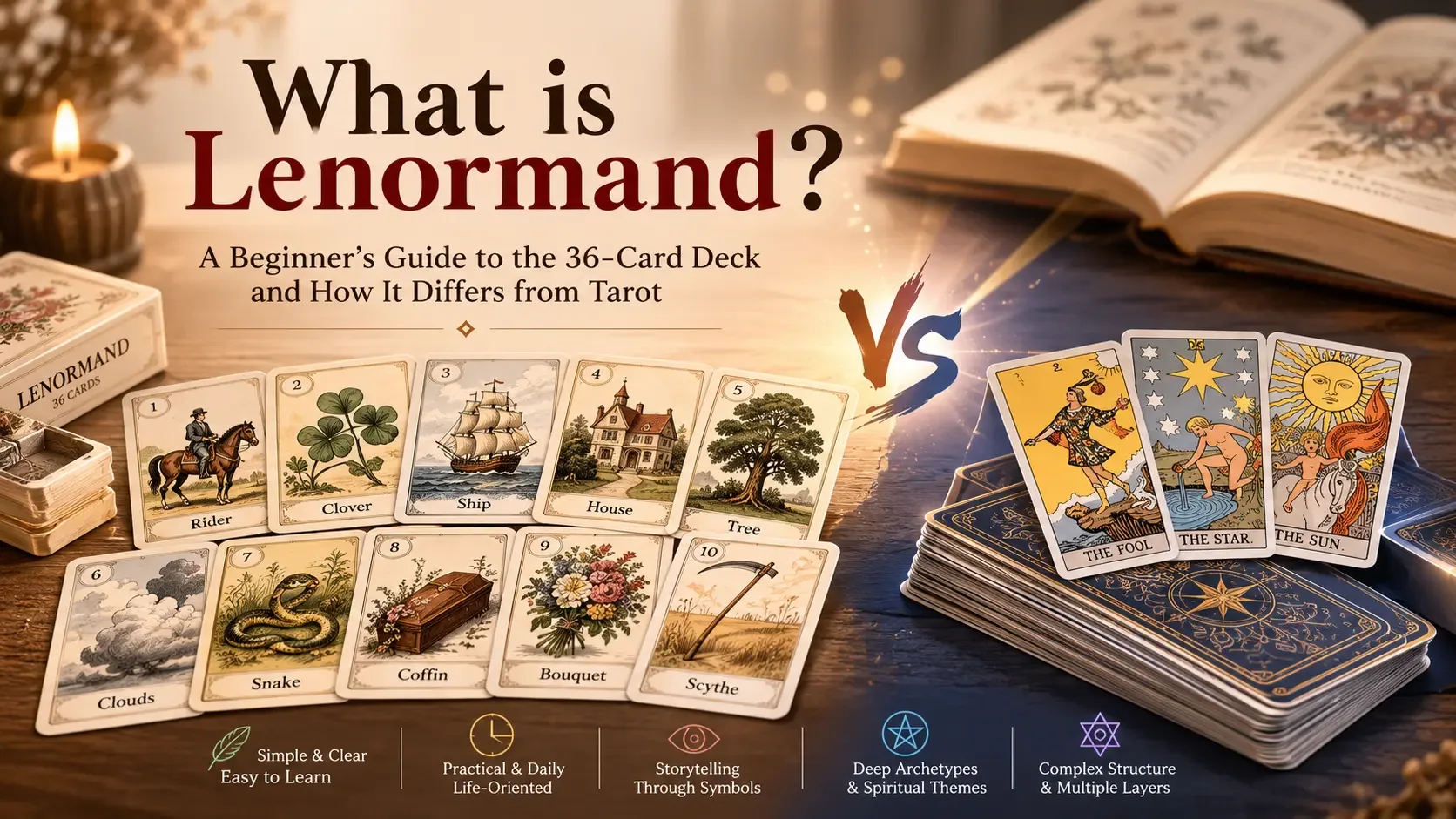
When exploring the world of intuitive card reading, most people immediately think of Tarot. However, a centuries-old European system is making a massive global comeback for readers seeking practical, direct, and real-world clarity: the Lenormand deck.
If you have been looking for an intuitive tool that cuts straight through the noise without requiring years of esoteric study, understanding Lenormand is one of the best steps you can take on your cartomancy journey.
1. The History and Origins of Lenormand
Named after Marie Anne Lenormand, the famous French fortune-teller who read cards for Napoleon and Empress Joséphine during the 18th and 19th centuries, the deck itself actually evolved from a 1799 German parlor game called The Game of Hope (Das Spiel der Hoffnung).
Unlike traditional Tarot, which relies heavily on Western astrology, Kabbalah, and Renaissance mysticism, Lenormand was designed around everyday, recognizable symbols. It was built to reflect the tangible realities of 19th-century life: messages arriving, journeys across the sea, loyal friends, financial contracts, and household news.
2. Structure: 36 Everyday Symbols vs. 78 Complex Archetypes
The fundamental difference between Tarot and Lenormand lies in their structure and design philosophy.
Deck Size: While a standard Tarot deck contains 78 cards divided into Major and Minor Arcana, a traditional Lenormand deck contains only 36 cards.
Concrete Imagery: Instead of complex visual narratives featuring mythical figures or astrological signs, Lenormand cards depict clear, singular icons:
The Rider (Card 1): News, arrivals, fast movement, messages.
The Clover (Card 2): Short-term luck, small surprises, lightheartedness.
The Ship (Card 3): Travel, long-distance trade, foreign matters, transitions.
The House (Card 4): Home, stability, domestic affairs, privacy.
The Key (Card 33): Solutions, certainty, unlocking answers, destiny.
Because the visual language is minimalist, reading Lenormand eliminates much of the guesswork that beginners face with traditional card reading.
3. How Lenormand Works: Language, Combinations, and Grammar
The real magic of Lenormand happens when cards interact with one another. In Tarot, pulling a single card like The Hermit or The Empress can lead to an in-depth 10-minute contemplation about inner spiritual states.
In Lenormand, individual cards rarely stand alone. Instead, Lenormand functions like a spoken sentence where cards act as nouns, verbs, and adjectives:
The Clover (Luck / Short-term) + The House (Home) = Unexpected good luck in home matters.
The Dog (Loyal Friend) + The Fox (Cunning / Work) = A clever colleague at work or a tricky friend.
The Letter (Written News) + The Ring (Contract / Commitment) = A formal written contract or marriage notice.
By combining cards in pairs or triplets, you construct precise, blunt answers to everyday questions regarding work, relationships, finances, and timing.
4. Tarot vs. Lenormand: Which One Should You Use?
Neither system is better than the other; they simply serve different purposes in your daily self-reflection routine:
Turn to Tarot when asking: "Why am I feeling emotionally blocked in my relationship?" or "What psychological shadow do I need to work on this month?"
Turn to Lenormand when asking: "What is the practical outcome of this business pitch?", "When will I hear back about my application?", or "How will the atmosphere be at tomorrow's meeting?"
While Tarot acts as a psychological mirror for internal growth, Lenormand acts as a practical compass for real-world situations.
5. How to Start Practicing Today
Getting started with Lenormand does not require memorizing thick handbooks or mastering complex rituals. Because the system relies on logical pairing and everyday concepts, practicing short daily draws is the fastest way to build intuitive confidence.
Whether you are looking to run quick 2-card combination exercises, explore clean card meanings, or try interactive digital readings in an ad-free environment, you can start exploring the deck right now at lenormand.live.
Recommended reading
How Many Cards Are in a Lenormand Deck?
If you are new to Lenormand, one of the first things you may notice is that a Lenormand deck is much smaller than a Tarot deck. A standard Lenormand deck…
Should Beginners Learn Tarot or Lenormand? A Complete Guide to Choosing the Right System
If you are just starting to explore divination, you may quickly come across a common question: Should I learn Tarot or Lenormand first? At first glance, both…
Lenormand vs Tarot: What Is the Difference Between These Two Systems?
Tarot and Lenormand are probably the two best-known card-based divination systems in the modern Western world. They are often mentioned together, and many…
The History of Lenormand Cards: From Fortune Telling to Modern Divination
Lenormand cards are one of the most fascinating divination systems in the world. Although they are often compared with tarot cards, Lenormand has its own…
An Introduction to the Grand Tableau: How to Read All 36 Lenormand Cards at Once
If you have spent any time exploring Lenormand cartomancy, you have likely encountered its ultimate signature reading: The Grand Tableau (GT). Unlike Tarot…