The History of Lenormand Cards: From Fortune Telling to Modern Divination
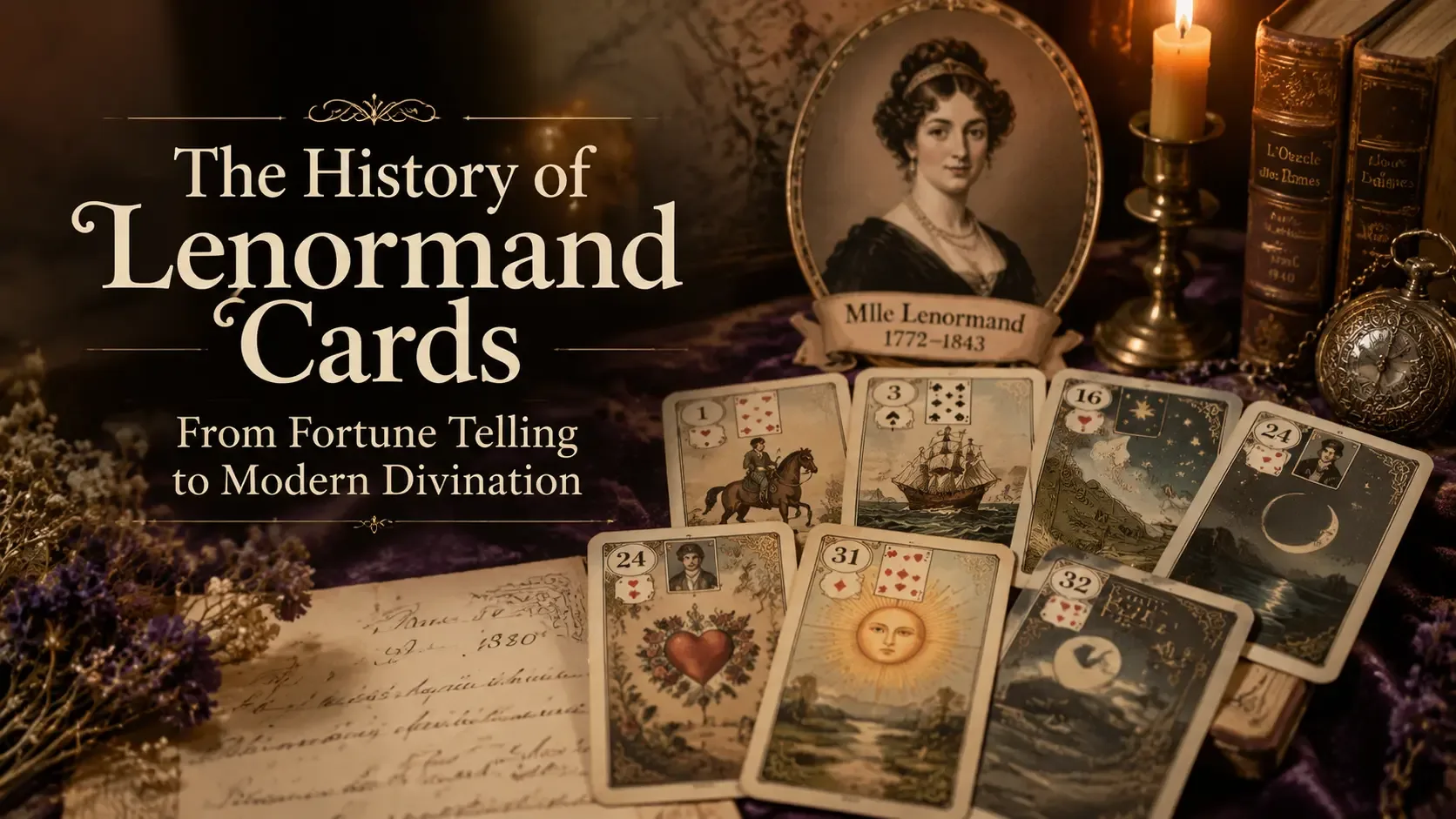
Lenormand cards are one of the most fascinating divination systems in the world. Although they are often compared with tarot cards, Lenormand has its own unique history, structure, and reading style.
Today, millions of people around the world use Lenormand cards for guidance, reflection, and divination. The famous 36-card deck is known for its simple symbols — such as the Sun, Moon, Ship, Key, Ring, and Heart — yet these images can create surprisingly detailed stories when combined.
But where did Lenormand cards come from?
How did a small fortune-telling deck from 19th-century Europe become a popular spiritual tool used around the world today?
This article explores the fascinating history of Lenormand cards, from their origins in European card culture to their modern revival.
What Are Lenormand Cards?
Before exploring their history, it is important to understand what Lenormand cards are.
A traditional Lenormand deck contains 36 cards, each featuring a simple symbolic image.
Examples include:
Rider
Clover
Ship
House
Tree
Clouds
Snake
Heart
Ring
Key
Sun
Moon
Unlike tarot, which often focuses on archetypes, spiritual lessons, and psychological themes, Lenormand is known for its direct and practical style.
A Lenormand reading usually combines multiple cards together to create a sentence-like interpretation.
For example:
Ship + Ring + Heart
may suggest:
A romantic relationship connected with travel
A long-distance relationship
A meaningful emotional journey
The power of Lenormand comes from the interaction between cards.
The Origins of Lenormand Cards
The history of Lenormand cards begins in Europe during the late 18th and early 19th centuries.
The exact origins of the deck are still debated, but most historians connect Lenormand cards with the popularity of European fortune-telling games and card divination practices.
During this period, card reading became increasingly popular among the public.
Playing cards were no longer used only for entertainment. Many people began using them for:
Fortune telling
Personal guidance
Exploring relationships
Understanding future possibilities
The development of Lenormand was part of this larger European tradition.
The Connection Between Lenormand and the Game of “Das Spiel der Hoffnung”
The earliest ancestor of modern Lenormand is often associated with a German card game called Das Spiel der Hoffnung (“The Game of Hope”), created around the late 18th century.
This game contained 36 illustrated cards with symbolic images.
The cards included themes such as:
The Rider
The House
The Tree
The Anchor
The Sun
The Moon
These symbols later became the foundation of the Lenormand system.
Originally, the cards were designed as a game rather than specifically as a fortune-telling tool.
Over time, however, people began using the images for divination.
Who Was Mademoiselle Lenormand?
The name “Lenormand” comes from one of the most famous fortune tellers in European history:
Marie Anne Lenormand
Born in France in 1772, Marie Anne Lenormand became famous during the Napoleonic era.
She was known for reading cards for many influential figures, including members of the French political elite.
Her clients were said to include:
Empress Joséphine, wife of Napoleon Bonaparte
Political leaders
Aristocrats
Because of her reputation, her name became strongly associated with card divination.
However, an important historical point is:
Marie Anne Lenormand did not create the Lenormand deck.
The 36-card deck known today as Lenormand was published after her lifetime.
Her fame helped popularize the association between her name and fortune-telling cards.
The Rise of Lenormand Cards in the 19th Century
After Marie Anne Lenormand’s death in 1843, publishers began producing card decks connected with her reputation.
The most famous version became the Petit Lenormand, a 36-card deck based on the earlier Game of Hope symbols.
During the 19th century, Lenormand cards spread throughout Europe.
They became especially popular in:
France
Germany
Belgium
Switzerland
Austria
Unlike tarot, which was often associated with occult philosophy, Lenormand developed a reputation as a practical fortune-telling system.
People used it to ask about:
Love and marriage
Money
Travel
Family matters
Everyday decisions
How Lenormand Differs From Tarot
Although both tarot and Lenormand are used for divination, their approaches are very different.
Tarot
Tarot usually focuses on:
Personal transformation
Psychological insights
Spiritual development
Inner conflicts
A tarot card often represents a broad archetypal concept.
For example:
The Hermit may represent:
Reflection
Wisdom
Searching inward
Lenormand
Lenormand focuses more on:
Events
Relationships
Practical situations
External circumstances
A Lenormand card usually has a clearer everyday meaning.
For example:
The House may represent:
Home
Family
Stability
The Ship may represent:
Travel
Distance
Exploration
The combination of cards creates a story.
The Grand Tableau: The Signature Lenormand Reading
One of the most famous Lenormand methods is the Grand Tableau.
The Grand Tableau uses all 36 cards in a single spread.
It allows readers to explore many areas of life:
Relationships
Career
Finances
Health
Personal development
Because every card interacts with surrounding cards, the Grand Tableau creates a complex map of possibilities.
Many experienced Lenormand readers consider it the ultimate expression of the system.
Lenormand Cards in the Modern World
In the 20th and 21st centuries, Lenormand experienced a revival.
Interest increased because of:
The growth of online spiritual communities
The popularity of tarot and divination content
The publication of new Lenormand decks
Digital reading platforms
Today, Lenormand is practiced worldwide.
Modern readers use Lenormand for:
Traditional fortune telling
Self-reflection
Creative exploration
Spiritual practice
The internet has also made Lenormand more accessible than ever before.
People can now learn card meanings, practice spreads, and explore readings online.
Why Are Lenormand Cards Still Popular Today?
The continuing popularity of Lenormand comes from several unique qualities.
1. Simple Symbols, Deep Combinations
A beginner can quickly understand individual cards.
For example:
Heart = love
Ring = commitment
Key = solution
But when cards combine, they create much deeper meanings.
2. Practical Guidance
Many people appreciate Lenormand because its messages often feel direct.
Instead of focusing only on abstract spiritual concepts, Lenormand often addresses real-life questions.
3. Storytelling Ability
Lenormand cards work almost like a visual language.
Individual cards become words.
Card combinations become sentences.
A spread becomes a story.
This makes Lenormand both accessible and endlessly interesting.
Learning Lenormand Today
For beginners, the best way to learn Lenormand is to start with:
Step 1: Learn the 36 Card Meanings
Understand the basic symbolism of each card.
Step 2: Practice Two-Card Combinations
For example:
Sun + Key
may suggest:
Success
A clear solution
Positive breakthrough
Step 3: Learn Three-Card Readings
Three cards help beginners understand how Lenormand creates narratives.
Step 4: Explore the Grand Tableau
After mastering the basics, readers can move into advanced techniques.
Conclusion: The Continuing Journey of Lenormand Cards
From a European card game to one of the world's most recognized divination systems, Lenormand cards have traveled through centuries of cultural change.
Although named after the famous fortune teller Marie Anne Lenormand, the deck itself developed through a longer history of European symbolic traditions.
Today, Lenormand remains popular because of its unique combination of simplicity and depth.
The 36 cards create a symbolic language that allows people to explore relationships, choices, possibilities, and the stories of their lives.
Whether you approach Lenormand as a spiritual practice, a historical tradition, or a tool for personal reflection, understanding its history provides a deeper appreciation of this fascinating card system.
Recommended reading
How Many Cards Are in a Lenormand Deck?
If you are new to Lenormand, one of the first things you may notice is that a Lenormand deck is much smaller than a Tarot deck. A standard Lenormand deck…
Should Beginners Learn Tarot or Lenormand? A Complete Guide to Choosing the Right System
If you are just starting to explore divination, you may quickly come across a common question: Should I learn Tarot or Lenormand first? At first glance, both…
Simple Lenormand Spreads: How to Do 2-Card, 3-Card, and 9-Card Box Readings
Unlike Tarot—which leans heavily into archetypes, psychological reflection, and esoteric symbolism—Lenormand is a practical, direct system designed for…
Understanding the 36 Lenormand Cards: Meanings in Love, Career, and Daily Guidance
A clean, cheat-sheet guide to concrete symbols from The Rider to The Cross. Whether you’re drawing a quick Card of the Day or laying out a full Grand Tableau…
How to Read Lenormand Card Combinations: Moving Beyond Rigid Rules to Real Context
If single Lenormand cards are the building blocks of a reading, combinations are where the story actually happens. Unlike Tarot—where pulling a single card often gives you enough visual and symbolic weight for an in-depth reading—Lenormand is fundamentally a paired system. A single Lenormand card like The Clover or The Ship rarely gives a full answer on its own. It is only when two or more cards interact that clear, actionable meaning emerges. However, many beginner tutorials oversimplify combination reading by teaching a rigid formula: "Card A is always the noun, and Card B is always the adjective."