Simple Lenormand Spreads: How to Do 2-Card, 3-Card, and 9-Card Box Readings
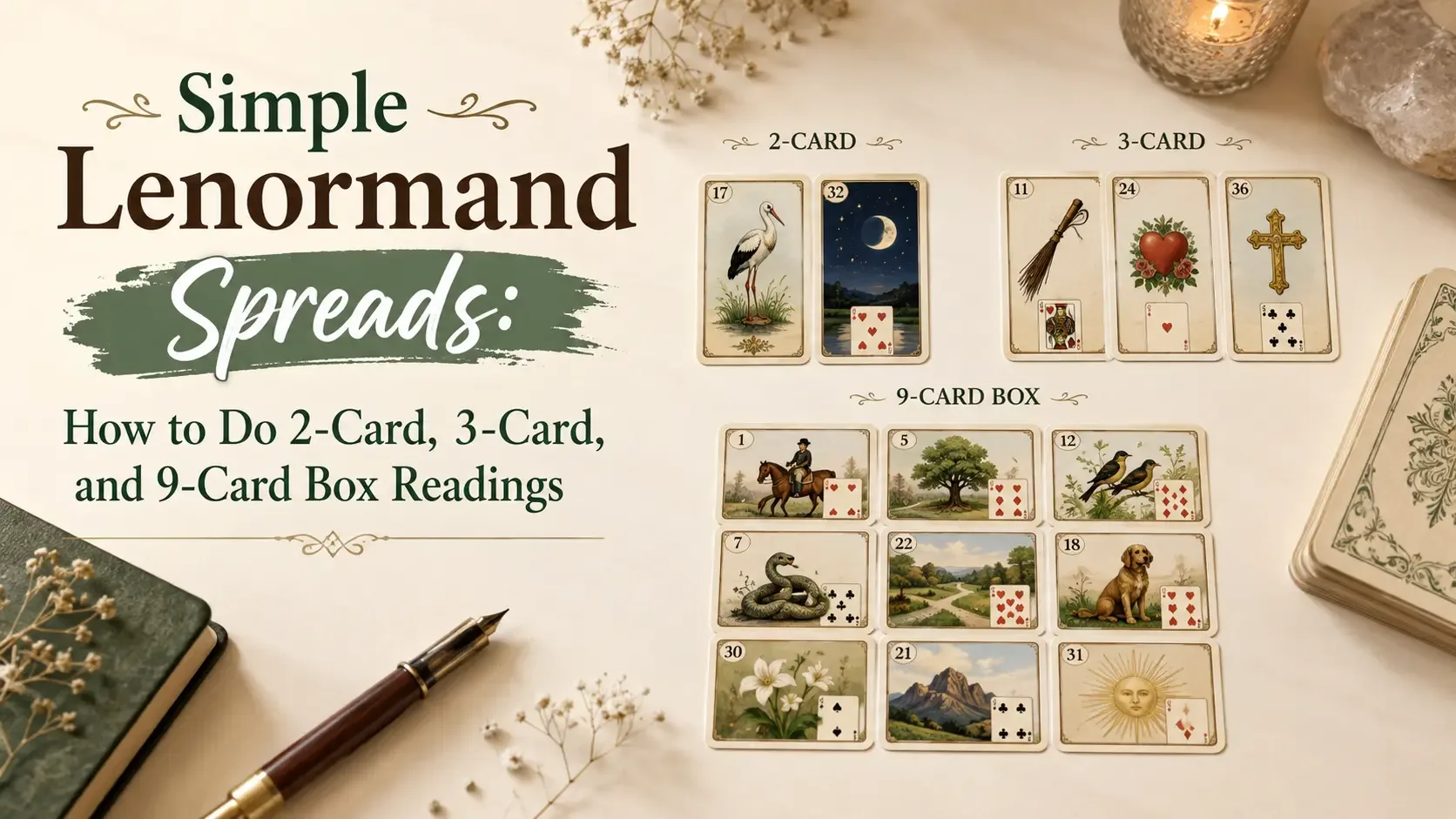
Unlike Tarot—which leans heavily into archetypes, psychological reflection, and esoteric symbolism—Lenormand is a practical, direct system designed for tangible, everyday questions. You don't need elaborate 21-card layouts or complex ritualistic setups to extract accurate insights. In fact, Lenormand shines brightest when kept clean, structured, and focused.
Because Lenormand cards operate like words in a sentence—where individual cards act as nouns and modifiers—mastering basic spreads is the single fastest way to build reading fluency and confidence.
Whether you’ve just picked up your first deck or want to sharpen your interpretation speed, here is a step-by-step guide to mastering the three core layouts every reader needs: the 2-Card Pair, the 3-Card Storyline, and the 9-Card Box Spread.
1. The 2-Card Combination: Building Your Sentence Structure
The absolute foundation of Lenormand is the Pairing Technique. A single card rarely gives a complete answer on its own; instead, Lenormand works by placing two cards side-by-side to form a composite concept.
Think of it like basic grammar:
Card 1 (The Noun / Subject): Establishes the core topic, object, or theme.
Card 2 (The Adjective / Modifier): Describes, qualifies, or alters the first card.
Real-World Examples:
Rider (1) + Letter (27): News or a message arriving quickly (Rider = quick delivery; Letter = physical message/document).
Clover (2) + Dog (18): A lucky or fortunate friendship (Clover = luck/opportunity; Dog = friend).
Fox (14) + Dog (18): A deceitful or self-serving friend (Fox = cunning/selfishness modifies the loyalty of the Dog).
When to use: Daily check-ins, straightforward single-question queries, or quick practice drills to build your combination memory.
2. The 3-Card Narrative Spread: Linear Storytelling
The 3-Card spread introduces chronology, movement, and context. It expands a simple pair into a mini-narrative with a clear beginning, middle, and potential outcome.
Reading Structure (Left to Right):
$$\text{[ Card 1: Past / Cause ]} \longrightarrow \text{[ Card 2: Present / Focal Point ]} \longrightarrow \text{[ Card 3: Future / Outcome ]}$$
While you can read this spread strictly chronologically, experienced Lenormand readers often view Card 2 as the central anchor, with Card 1 and Card 3 modifying it from either side.
Sample Reading: "How will my upcoming contract negotiation go?"
Cards Pulled: Tower (19) + Anchor (35) + Sun (31)
Tower (19): Represents a formal corporate entity, official institution, or legal framework.
Anchor (35): Represents security, long-term stability, and firm agreement.
Sun (31): Predicts high energy, clarity, success, and a favorable outcome.
The Interpretation: The negotiation begins with a structured corporate framework (Tower), stabilizes through solid common ground (Anchor), and concludes with a resounding success (Sun).
When to use: Specific situational inquiries where you need to understand cause, current status, and practical trajectory.
3. The 9-Card Box Spread (3x3): Deep-Dive Micro-Readings
When you need a comprehensive overview of a complex situation without laying out a full 36-card Grand Tableau, the 9-Card Box Spread is your best tool. It packs nuance, hidden influences, surrounding atmosphere, and timeline progression into nine structured cards.
Layout Setup:
Column 1 (Past)Column 2 (Present)Column 3 (Future)12345 (Significator)6789
How to Decode the 3x3 Box:
Card 5 (Center / Focus): The heart of the matter. Every other card in the spread anchors back to this focal point.
The Corners (1, 3, 7, 9): Set the overall tone and external atmosphere surrounding the issue.
Horizontal Rows:
Top Row (1, 2, 3): What’s on your mind—conscious thoughts, hopes, or immediate plans.
Middle Row (4, 5, 6): The current physical reality and core event line.
Bottom Row (7, 8, 9): Underlying factors—unconscious drivers, hidden influences, or grounded results.
Vertical Columns:
Left Column (1, 4, 7): Past influences leading up to now.
Middle Column (2, 5, 8): Present dynamics active right now.
Right Column (3, 6, 9): Near-future developments.
Diagonals (1-5-9 & 3-5-7): Cross-currents that reveal deeper cause-and-effect paths.
Pro Tip: Advanced readers also "mirror" opposing cards (e.g., pairing Card 1 with Card 9) to reveal hidden connections beneath the surface.
Actionable Tips to Build Your Reading Muscle Today
Ask precise, grounded questions: Lenormand thrives on specifics. Instead of asking "What is my life purpose?", ask "What obstacles should I anticipate in my business launch this week?"
Keep a daily reading log: Record your morning 2-card or 3-card pulls. Revisit them at night to observe how literal card combinations manifested in your day-to-day events.
Practice digital draws for fast feedback: Testing combinations and checking card meanings on the go accelerates your intuitive recall.
If you want to practice these spreads digitally or need an instant, accurate reference tool while reading, check out lenormand.live. It features interactive daily draws, digital 3x3 box layouts, and comprehensive card combination guides to help you master Lenormand effortlessly.
Recommended reading
How Many Cards Are in a Lenormand Deck?
If you are new to Lenormand, one of the first things you may notice is that a Lenormand deck is much smaller than a Tarot deck. A standard Lenormand deck…
Should Beginners Learn Tarot or Lenormand? A Complete Guide to Choosing the Right System
If you are just starting to explore divination, you may quickly come across a common question: Should I learn Tarot or Lenormand first? At first glance, both…
Lenormand vs Tarot: What Is the Difference Between These Two Systems?
Tarot and Lenormand are probably the two best-known card-based divination systems in the modern Western world. They are often mentioned together, and many…
The History of Lenormand Cards: From Fortune Telling to Modern Divination
Lenormand cards are one of the most fascinating divination systems in the world. Although they are often compared with tarot cards, Lenormand has its own…
How to Read Lenormand Card Combinations: Moving Beyond Rigid Rules to Real Context
If single Lenormand cards are the building blocks of a reading, combinations are where the story actually happens. Unlike Tarot—where pulling a single card often gives you enough visual and symbolic weight for an in-depth reading—Lenormand is fundamentally a paired system. A single Lenormand card like The Clover or The Ship rarely gives a full answer on its own. It is only when two or more cards interact that clear, actionable meaning emerges. However, many beginner tutorials oversimplify combination reading by teaching a rigid formula: "Card A is always the noun, and Card B is always the adjective."