An Introduction to the Grand Tableau: How to Read All 36 Lenormand Cards at Once
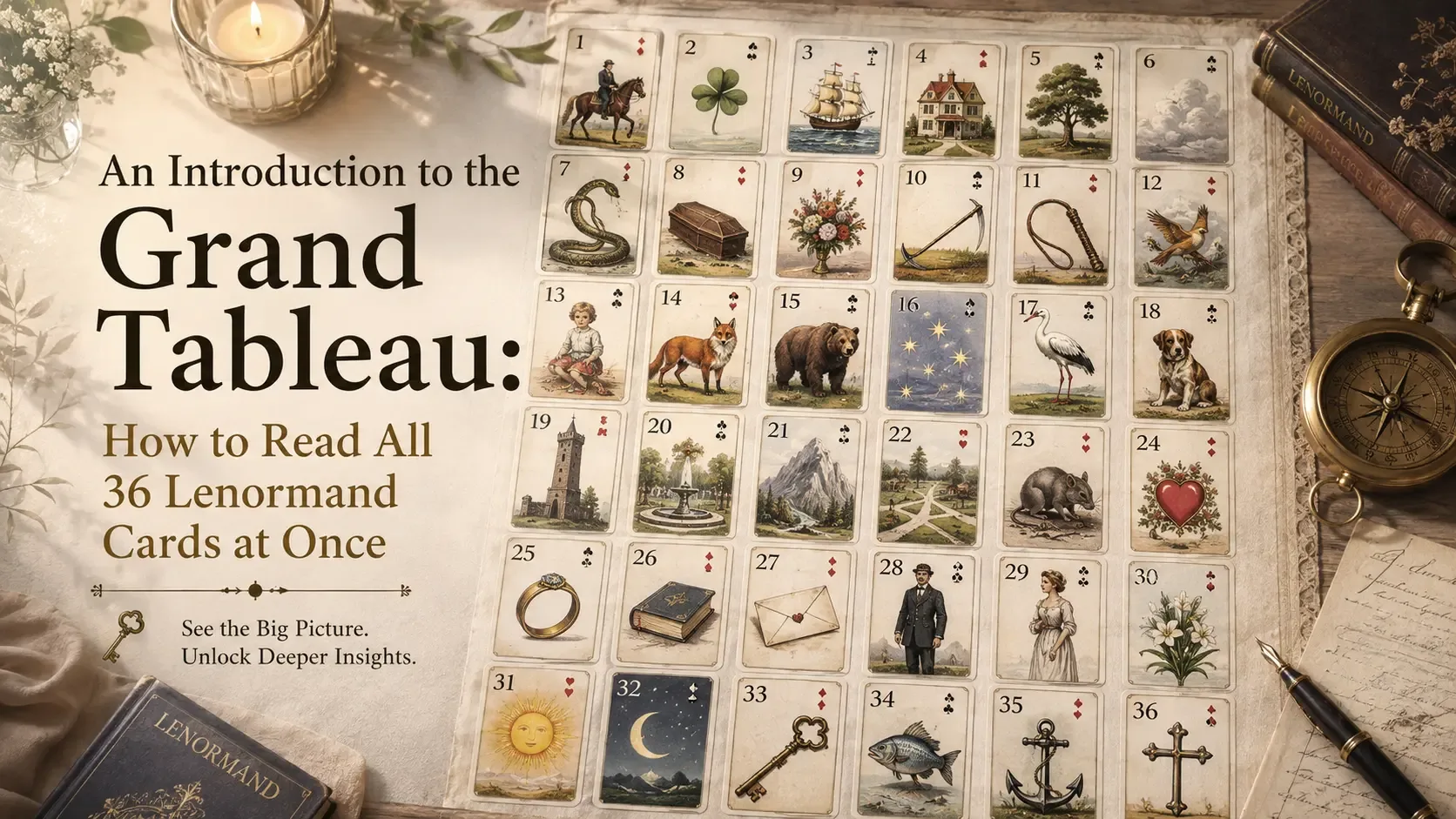
If you have spent any time exploring Lenormand cartomancy, you have likely encountered its ultimate signature reading: The Grand Tableau (GT).
Unlike Tarot spreads that assign rigid meanings to specific positions—or minor card draws that answer isolated questions—the Grand Tableau lays out all 36 Lenormand cards simultaneously. The result is a complete, panoramic blueprint of the seeker's past, present, future, and inner life.
While looking at 36 cards laid out on a table can feel overwhelming to beginners, the Grand Tableau follows logical, structured system rules. Once you learn how to navigate its grid, you will unlock unmatched accuracy in timing, life mapping, and situational analysis.
Here is your introductory roadmap to reading all 36 cards with confidence.
📐 The Two Grand Tableau Formats
Before laying out your cards, choose which grid layout fits your physical deck and reading style.
1. The 8x4 + 4 Layout (Most Common)
This traditional format arranges 32 cards into 4 horizontal rows of 8 cards each, with 4 remaining cards centered along the bottom as a final row.
Rows 1–4: Show the active dynamics, influences, and events surrounding your life.
The Bottom 4 Cards (Fate / Fate Line): Represent core outcomes, unexpected shifts, or underlying thematic conclusions.
Plaintext
[ Card 01 ] [ Card 02 ] [ Card 03 ] [ Card 04 ] [ Card 05 ] [ Card 06 ] [ Card 07 ] [ Card 08 ]
[ Card 09 ] [ Card 10 ] [ Card 11 ] [ Card 12 ] [ Card 13 ] [ Card 14 ] [ Card 15 ] [ Card 16 ]
[ Card 17 ] [ Card 18 ] [ Card 19 ] [ Card 20 ] [ Card 21 ] [ Card 22 ] [ Card 23 ] [ Card 24 ]
[ Card 25 ] [ Card 26 ] [ Card 27 ] [ Card 28 ] [ Card 29 ] [ Card 30 ] [ Card 31 ] [ Card 32 ]
            [ Card 33 ] [ Card 34 ] [ Card 35 ] [ Card 36 ]
2. The 9x4 Layout
This layout places the cards into a perfect grid of 4 rows containing 9 cards each. It is favored by readers who prefer symmetrical houses and clean vertical columns for timing and direct alignment.
🗺️ Step-by-Step Navigation Guide
Do not attempt to read all 36 cards at once from left to right. Instead, decode the Grand Tableau by following a systematic sequence.
       [ Above: Mind / Conscious ]
                    │
[ Left: Past ] ─── [ SIGNIFICATOR ] ─── [ Right: Future ]
                    │
       [ Below: Ground / Subconscious ]
Step 1: Locate the Significator
Identify the card that represents the person receiving the reading:
Card 28 (Man / Animus): Male querent or primary male partner.
Card 29 (Woman / Anima): Female querent or primary female partner.
Locating the Significator gives you your anchor point on the board.
Step 2: Read the Cross Matrix Around the Significator
Examine the cards immediately touching the Significator above, below, behind, and in front:
Behind (Left): Past events and influences that led to the current moment.
In Front (Right): Incoming future developments and approaching events.
Above (Head Line): Thoughts, conscious worries, plans, and active intentions.
Below (Feet Line): Grounded realities, subconscious patterns, or things the seeker is ignoring or standing upon.
Step 3: Analyze the 4 Corners
Look at the cards placed in the four extreme outer corners of the layout (Positions 1, 8, 25, and 32 in an 8x4 layout).
These four cornerstones set the overarching tone and main theme of the reading during this phase of life.
Step 4: Examine Topic Focus Cards
To investigate specific areas of life, locate key anchor cards across the board:
❤️ Love & Relationships: Heart (24) and Ring (25)
💼 Career & Ambition: Fox (14) and Anchor (35)
💰 Finance & Wealth: Fish (34) and Bear (15)
🏠 Home & Family: House (04) and Tree (05)
Look at the cards surrounding these topic anchors to evaluate the health and direction of those specific life areas.
🔍 Advanced Techniques for Precision
Once you master the basic steps, incorporate these techniques to extract deeper details:
1. Knighting (L-Shaped Movements)
Borrowed from chess, "knighting" connects a primary card to another card located two steps away vertically/horizontally and one step orthogonally. This reveals hidden motives, secret influences, or subconscious drivers operating behind the scenes.
2. House System Mapping
In a Grand Tableau, every physical position on the board corresponds to a natural card number (Position 1 belongs to the House of the Rider, Position 2 to the House of the Clover, and so on).
Example: If Card 24 (The Heart) lands in Position 10 (House of the Scythe), it indicates a sudden emotional cut or unexpected romantic decision.
3. Diagonals for Hidden Timelines
Horizontal lines read as direct chronology (Past → Future). Diagonal lines cutting through the Significator reveal secondary storylines, personal habits, and underlying momentum shaping the narrative.
💡 Best Practices for Grand Tableau Practice
Photograph Your Spread: Grand Tableaus track long timeframes (typically 3 to 6 months). Take a photo of your board so you can return to it as events unfold.
Start with a Clear Question or Focus: State your primary objective before shuffling, whether you want an overall quarterly life audit or a targeted focus on career and business.
Keep a Journal: Record your house combinations and knighting pairs to refine your personal system over time.
Ready to map out your full spread? Access advanced combination lookup tools, house matrix guides, and interactive Grand Tableau practice routines at lenormand.live.
Recommended reading
How Many Cards Are in a Lenormand Deck?
If you are new to Lenormand, one of the first things you may notice is that a Lenormand deck is much smaller than a Tarot deck. A standard Lenormand deck…
Should Beginners Learn Tarot or Lenormand? A Complete Guide to Choosing the Right System
If you are just starting to explore divination, you may quickly come across a common question: Should I learn Tarot or Lenormand first? At first glance, both…
Lenormand vs Tarot: What Is the Difference Between These Two Systems?
Tarot and Lenormand are probably the two best-known card-based divination systems in the modern Western world. They are often mentioned together, and many…
Understanding the 36 Lenormand Cards: Meanings in Love, Career, and Daily Guidance
A clean, cheat-sheet guide to concrete symbols from The Rider to The Cross. Whether you’re drawing a quick Card of the Day or laying out a full Grand Tableau…
How to Read Lenormand Card Combinations: Moving Beyond Rigid Rules to Real Context
If single Lenormand cards are the building blocks of a reading, combinations are where the story actually happens. Unlike Tarot—where pulling a single card often gives you enough visual and symbolic weight for an in-depth reading—Lenormand is fundamentally a paired system. A single Lenormand card like The Clover or The Ship rarely gives a full answer on its own. It is only when two or more cards interact that clear, actionable meaning emerges. However, many beginner tutorials oversimplify combination reading by teaching a rigid formula: "Card A is always the noun, and Card B is always the adjective."