Lenormand vs Tarot: What Is the Difference Between These Two Systems?
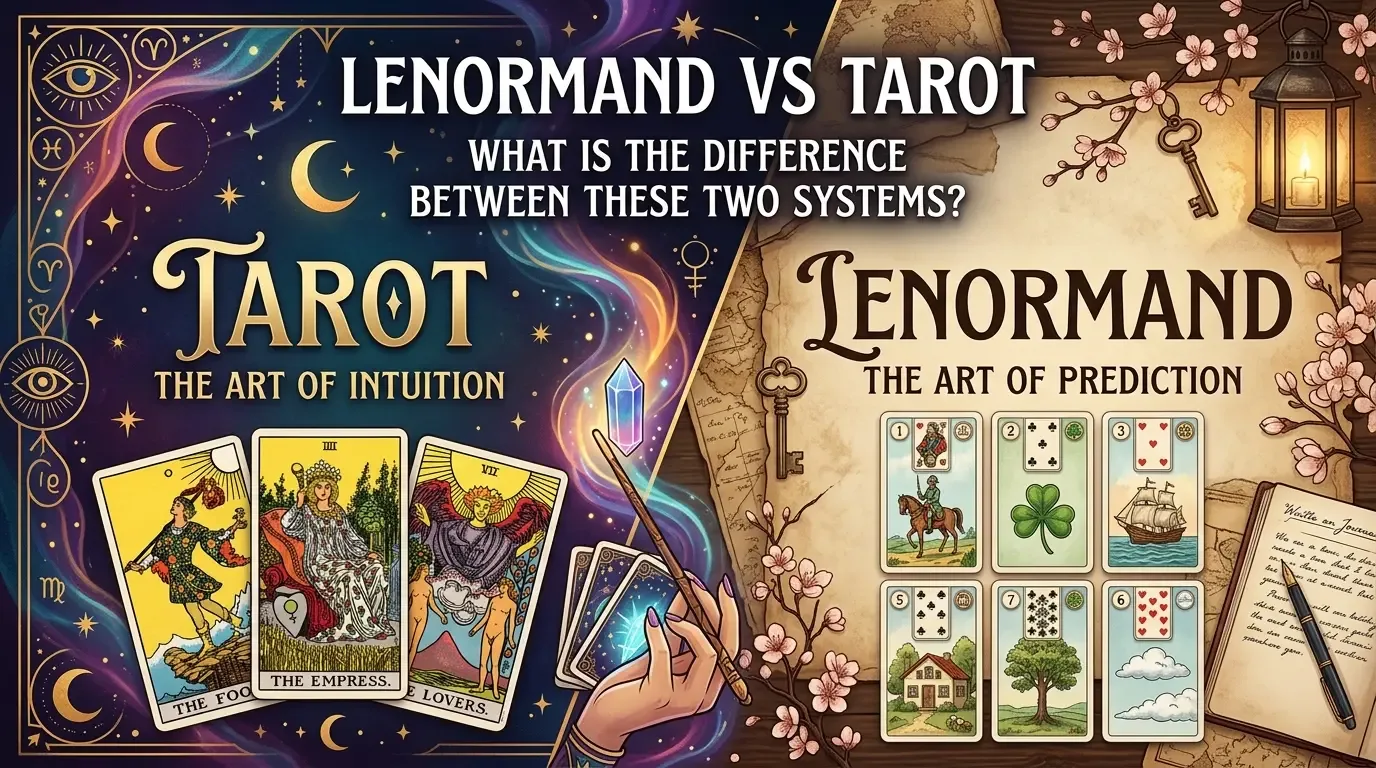
Tarot and Lenormand are probably the two best-known card-based divination systems in the modern Western world. They are often mentioned together, and many beginners assume that Lenormand is simply a smaller or simpler version of Tarot.
It isn't.
Although both systems use cards to explore questions about relationships, work, decisions, emotions, and everyday life, Tarot and Lenormand are built on very different structures and reading principles.
Understanding this difference is important if you are learning either system—or deciding which one is better suited to your style of reading.
Tarot and Lenormand at a Glance
Tarot | Lenormand | |
|---|---|---|
Standard deck | 78 cards | 36 cards |
Main structure | Major & Minor Arcana | 36-card fixed deck |
Card imagery | Symbolic and often complex | Concrete and recognizable |
Reading style | Psychological, symbolic, archetypal | Practical, contextual, combinational |
Typical question | “What is happening beneath the surface?” | “What is likely to happen?” |
Card relationships | Important | Extremely important |
Short spreads | Very common | Very common |
Large spreads | Celtic Cross, etc. | Grand Tableau |
Learning curve | Relatively broad | Easier to begin, deeper with practice |
This table gives us the basic distinction, but the real differences become clearer when we look at how the two systems actually work.
1. Tarot Has 78 Cards, Lenormand Has 36
The most obvious difference is the number of cards.
A standard Tarot deck contains 78 cards:
22 Major Arcana
56 Minor Arcana
Four suits
Court cards
Lenormand traditionally contains 36 cards, each with a relatively direct image and established meaning.
For example, a Lenormand deck includes cards such as:
Rider
Clover
Ship
House
Tree
Clouds
Heart
Ring
Book
Key
Anchor
Cross
The images are much more concrete than many Tarot cards.
This does not mean that Lenormand is “less sophisticated.” It means that the two systems organize information differently.
Tarot gives the reader a much larger vocabulary of symbolic concepts.
Lenormand works more like a compact language in which cards are combined to produce meaning.
2. Tarot Is More Symbolic; Lenormand Is More Concrete
This is perhaps the most useful distinction for beginners.
Consider the Tarot card The Moon.
The Moon can suggest:
uncertainty
intuition
dreams
illusion
hidden information
anxiety
subconscious material
Its interpretation depends heavily on the question, surrounding cards, position in a spread, and the reader's understanding of Tarot symbolism.
Now compare that with a Lenormand card such as The House.
The House commonly points toward:
home
family
property
domestic matters
stability
one's personal environment
It is usually much easier to identify the general subject.
This is why Lenormand can sometimes feel surprisingly direct.
A Tarot card may ask:
“What does this situation mean?”
A Lenormand card often asks:
“What is happening?”
That distinction is not absolute, but it is a useful way to understand the two systems.
3. Tarot Often Explores States; Lenormand Often Describes Events
Tarot is particularly well suited to exploring psychological and emotional dimensions.
For example, if someone asks:
“Why am I having difficulty moving on from this relationship?”
A Tarot reading can explore:
emotional attachment
fears
unconscious patterns
personal beliefs
lessons
internal conflicts
possible growth
Lenormand can answer the same question, but it often approaches the problem differently.
For example, a combination involving Heart + Clouds + Book might suggest emotional confusion connected with something unknown, hidden, or not fully understood.
Lenormand tends to describe the situation and its connections.
Tarot often gives more room to explore the inner experience of the person involved.
Neither approach is inherently better.
They simply answer different kinds of questions particularly well.
4. Lenormand Relies Heavily on Card Combinations
This is one of the biggest differences between the two systems.
In Tarot, a single card can carry an enormous amount of information.
A reader might draw The Hermit and discuss:
solitude
introspection
wisdom
withdrawal
searching for answers
spiritual development
In Lenormand, individual cards are generally more limited.
Instead, the cards begin to become powerful when they interact.
For example:
Heart + Ring
can suggest a romantic commitment or relationship.
Ship + Anchor
may point toward long-distance work, travel connected with employment, or a stable connection to a foreign place, depending on context.
Letter + Ring
could indicate a written agreement, contract, formal communication, or relationship-related message.
The meaning emerges from the combination, not simply from one card.
This is why learning Lenormand is somewhat like learning a language.
You first learn vocabulary.
Then you learn how words work together.
Eventually, you can read an entire sentence.
5. Tarot Has a Strong Archetypal Dimension
Tarot contains a rich archetypal structure.
The Major Arcana alone presents a symbolic journey from The Fool through The World.
Cards such as:
The Magician
The High Priestess
The Empress
The Emperor
Death
The Devil
The Tower
The Star
The Sun
The World
can represent broad human experiences and psychological patterns.
Because of this, Tarot is frequently used for:
self-reflection
spiritual exploration
psychological insight
personal development
exploring motivations
understanding emotional patterns
Lenormand generally has a much more practical vocabulary.
A House is usually about home.
A Ship usually involves movement, travel, distance, or foreign matters.
A Fish can involve money, business, abundance, or commerce.
A Letter concerns communication or documents.
The cards can certainly become deeper in context, but they generally begin with something concrete.
6. Lenormand Is Often More Direct for Everyday Questions
This is where Lenormand can be especially attractive.
Suppose someone asks:
“Will I receive a reply to my message?”
A Lenormand reading may use cards such as:
Letter + Rider + Sun
This immediately creates a narrative:
communication → arrival → positive outcome.
The cards can be read almost like a sentence.
Tarot can answer the same question, of course, but its vocabulary may produce a more nuanced interpretation involving motivations, emotions, obstacles, or underlying dynamics.
For practical, event-oriented questions, many readers find Lenormand exceptionally efficient.
7. The Grand Tableau Is Unique to Lenormand
One of the defining features of Lenormand is the Grand Tableau, a spread using all 36 cards.
Instead of asking one small question and drawing three or five cards, the reader lays out the entire deck.
This creates a large map of the querent's circumstances.
The Grand Tableau can be used to examine:
relationships
career
finances
family
travel
important people
opportunities
obstacles
upcoming developments
It is one of the reasons Lenormand is much more than a simple “three-card oracle.”
The Grand Tableau also demonstrates the fundamental philosophy of Lenormand particularly well:
meaning is created through relationships between cards.
8. Tarot Spreads and Lenormand Spreads Work Differently
Tarot readers commonly use spreads such as:
One Card
Three Card Spread
Celtic Cross
Relationship Spread
Past–Present–Future
Horseshoe Spread
In many Tarot spreads, each position has a specific conceptual role.
For example:
What do I need to know?
What is blocking me?
What can I do?
What is the likely outcome?
Lenormand can use positions too, but many Lenormand readings place greater emphasis on sequence and proximity.
The cards are often read from left to right, as combinations, pairs, or clusters.
This gives Lenormand readings a distinctive narrative quality.
9. Tarot Can Be More Open-Ended
Another important difference is the amount of interpretive freedom.
Tarot cards are deliberately rich in symbolism.
Take The Tower.
Depending on the question and surrounding cards, it can suggest:
sudden change
disruption
revelation
collapse
liberation
destruction of an old structure
a dramatic realization
The reader must determine which interpretation fits the situation.
Lenormand tends to constrain interpretation more strongly.
For example, Scythe has a relatively recognizable conceptual field:
cutting
separation
sudden action
removal
harvesting
The surrounding cards determine what is being cut, removed, or changed.
This makes Lenormand feel more structured.
Tarot gives you a broad symbolic landscape.
Lenormand gives you a more defined vocabulary.
10. Which System Is Easier to Learn?
For absolute beginners, Lenormand can appear easier.
There are only 36 cards, and the basic meanings are relatively concrete.
You don't initially need to memorize:
22 Major Arcana
56 Minor Arcana
four elemental suits
court-card personalities
reversed meanings
extensive symbolic correspondences
But there is a catch.
Lenormand is easy to start and difficult to master.
The challenge moves from memorizing individual cards to understanding combinations.
A beginner might know:
Heart = love
Ring = commitment
But an experienced reader needs to understand how those cards behave in different contexts and how they interact with neighboring cards.
That is a very different skill.
11. Can You Use Both Tarot and Lenormand?
Absolutely.
In fact, many experienced readers eventually study both.
They can complement each other very well.
For example, Tarot can be used to explore:
What is really happening emotionally?
Lenormand can then be used to explore:
What is likely to happen in the practical situation?
You might think of them this way:
Tarot = depth and perspective
Lenormand = structure and circumstances
This doesn't mean that Tarot cannot predict events or that Lenormand cannot provide psychological insight. Both systems are flexible.
The distinction is about their natural strengths, not rigid rules.
12. Tarot vs Lenormand: Which One Should You Learn?
There is no universal winner.
Choose Tarot if you are particularly interested in:
symbolism
psychology
spirituality
archetypes
personal development
complex emotional questions
exploring the deeper meaning of situations
Choose Lenormand if you are particularly interested in:
practical questions
relationships
everyday events
timing and developments
concrete circumstances
reading combinations
straightforward narratives
And if you enjoy both approaches, there is no reason to choose only one.
Many readers eventually discover that Tarot and Lenormand feel less like competing systems and more like two different languages for looking at the same human experience.
Final Thoughts
The biggest mistake a beginner can make is assuming that Lenormand is simply a “simpler Tarot.”
It isn't.
Tarot and Lenormand developed along different paths and have different internal structures, vocabularies, and reading techniques.
Tarot tends to invite the reader into a symbolic world of archetypes, emotions, psychology, and transformation.
Lenormand tends to build meaning through concrete images, combinations, proximity, and narrative.
If Tarot is like exploring a person's inner landscape, Lenormand is often more like looking at a map of the situation.
And that difference is exactly what makes Lenormand so interesting.
If you are learning Lenormand for the first time, start with the 36 individual cards—but don't stop there. The real language of Lenormand begins when two, three, or more cards start talking to one another.
That is where the system truly comes alive.
Recommended reading
How Many Cards Are in a Lenormand Deck?
If you are new to Lenormand, one of the first things you may notice is that a Lenormand deck is much smaller than a Tarot deck. A standard Lenormand deck…
An Introduction to the Grand Tableau: How to Read All 36 Lenormand Cards at Once
If you have spent any time exploring Lenormand cartomancy, you have likely encountered its ultimate signature reading: The Grand Tableau (GT). Unlike Tarot…
Simple Lenormand Spreads: How to Do 2-Card, 3-Card, and 9-Card Box Readings
Unlike Tarot—which leans heavily into archetypes, psychological reflection, and esoteric symbolism—Lenormand is a practical, direct system designed for…
Understanding the 36 Lenormand Cards: Meanings in Love, Career, and Daily Guidance
A clean, cheat-sheet guide to concrete symbols from The Rider to The Cross. Whether you’re drawing a quick Card of the Day or laying out a full Grand Tableau…
How to Read Lenormand Card Combinations: Moving Beyond Rigid Rules to Real Context
If single Lenormand cards are the building blocks of a reading, combinations are where the story actually happens. Unlike Tarot—where pulling a single card often gives you enough visual and symbolic weight for an in-depth reading—Lenormand is fundamentally a paired system. A single Lenormand card like The Clover or The Ship rarely gives a full answer on its own. It is only when two or more cards interact that clear, actionable meaning emerges. However, many beginner tutorials oversimplify combination reading by teaching a rigid formula: "Card A is always the noun, and Card B is always the adjective."