Should Beginners Learn Tarot or Lenormand? A Complete Guide to Choosing the Right System
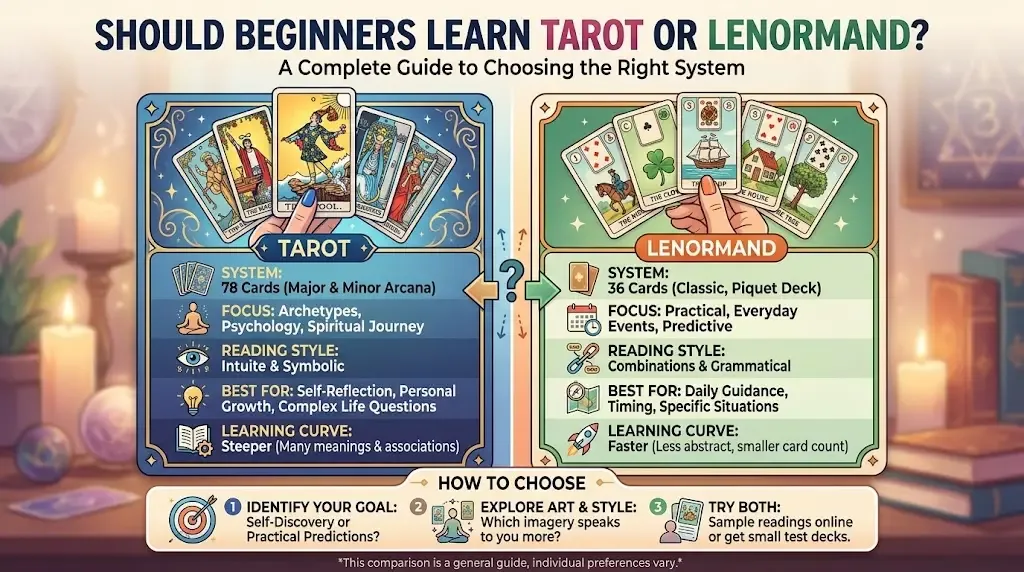
If you are just starting to explore divination, you may quickly come across a common question:
Should I learn Tarot or Lenormand first?
At first glance, both seem to be card-based divination systems. Both can be used to explore questions about love, relationships, career, money, and everyday life.
But once you actually start learning them, you will discover that they are two very different systems.
So if you are trying to choose where to begin, instead of asking which one is “better,” it may be more useful to ask:
Which style of interpretation suits you better?
What Is the Biggest Difference Between Tarot and Lenormand?
In simple terms:
Tarot is often more focused on a person’s inner world and the story behind a situation, while Lenormand tends to focus more directly on events, circumstances, and how a situation may unfold.
Tarot traditionally consists of 78 cards: 22 Major Arcana cards and 56 Minor Arcana cards.
Each card can carry layers of symbolism and can be used to explore emotions, motivations, psychological states, personal growth, and life experiences.
For example, if you ask:
“Why has this person suddenly become distant from me?”
Tarot may explore their emotions, psychological state, defenses, relationship patterns, and underlying motivations.
Lenormand tends to be more concrete.
Its traditional deck contains 36 cards, featuring recognizable symbols such as people, objects, animals, places, and everyday situations.
With the same question, a Lenormand reading may focus more on:
“What is happening in this relationship, and what might happen next?”
So this is not really about which system is more powerful or accurate.
They are more like two different languages for interpreting situations.
Is Lenormand Easier for Complete Beginners?
Interestingly, yes.
Many beginners who start with Tarot quickly discover that 78 cards represent a considerable amount of information.
You may need to learn the Major and Minor Arcana, the four suits, numbers, court cards, symbolism, elemental associations, reversals, and—perhaps most importantly—how cards interact with one another.
The same card can also mean very different things depending on the question.
For example, the Death card does not necessarily mean literal death.
The Lovers does not necessarily mean romance.
The Tower does not automatically mean disaster.
For someone who has just started learning Tarot, this can easily lead to the question:
“So how exactly am I supposed to interpret this card?”
Lenormand can feel more approachable in this respect.
Its symbols are generally much more concrete.
For example:
Heart is commonly associated with love, affection, and emotions.
Ring can relate to relationships, commitments, agreements, or contracts.
Letter can point to messages, written communication, documents, or notifications.
Ship can suggest travel, distance, movement, or foreign connections.
Key is often associated with solutions, certainty, important opportunities, or something significant.
Because the symbols are relatively concrete, beginners can start by observing what a card depicts and gradually build their understanding of its meanings.
You do not necessarily have to memorize a huge amount of abstract symbolism from day one.
But Lenormand Becomes Challenging When You Start Reading Combinations
This is one of the most important things for beginners to understand.
Individual Lenormand cards are not particularly difficult to learn.
The real depth comes from how the cards work together.
For example:
Heart + Ring
may suggest a romantic relationship or an emotional commitment.
Letter + Birds
may point toward messages, conversations, texting, or phone calls.
Ship + World
may bring themes of overseas travel, international connections, distance, or foreign countries into the reading.
But Lenormand is not simply about putting the keywords of each card next to one another.
The real skill lies in understanding:
How does one card modify another?
What new meaning appears when two cards are combined?
How does a sequence of three, five, or more cards form a coherent story?
This is why Lenormand can be described as:
Easy to start, but rewarding to study deeply.
Who Is Tarot Better Suited For?
If you are interested in psychology, symbolism, mythology, personality, spirituality, or personal growth, Tarot may be especially appealing.
Tarot has an incredibly rich symbolic system.
You can explore why the Fool represents beginnings, why the Hermit is associated with solitude and inner searching, or what the Emperor, Empress, Death, Devil, and Star represent on different levels.
As you become more experienced, you may realize:
Tarot is not simply about memorizing card meanings.
It is more like learning a symbolic language.
A single card can be interpreted from several different perspectives.
For example, the Hermit can represent solitude, reflection, searching for answers, temporarily withdrawing from the outside world, wisdom, or inner exploration.
That flexibility is one of Tarot's greatest strengths.
But it also means that:
Tarot generally has a longer learning curve.
Who Is Lenormand Better Suited For?
If you prefer concrete and practical questions, Lenormand may feel very natural.
For example:
“Will they contact me?”
“Do I have a chance of getting this job?”
“Will this business deal work out?”
“Am I likely to move soon?”
“What is likely to happen next?”
These types of questions often fit naturally with Lenormand's style.
Lenormand cards frequently point toward very tangible aspects of everyday life:
People, messages, documents, transportation, homes, work, money, travel, relationships, obstacles, opportunities, and more.
Rather than focusing heavily on:
“Why do I feel this way?”
Lenormand often directs attention toward:
“What is happening, and where might this situation be going?”
That is also why many people find Lenormand surprisingly vivid once they start using it.
The cards can create a very concrete picture of a situation.
So Which One Should a Beginner Learn First?
If you want a straightforward recommendation:
If you want to start with one system and get practical reading experience relatively quickly, I would recommend starting with Lenormand.
The reason is simple.
There are only 36 cards, the symbols are relatively concrete, and you can gradually develop your reading skills through card combinations.
You do not need to master a huge theoretical framework at the beginning.
You can start by learning the 36 cards, then move on to two-card combinations, followed by three-card readings, five-card lines, and eventually more advanced spreads.
This makes it relatively easy to practice and see how your interpretation develops.
However, if you are genuinely fascinated by Tarot, there is no reason to force yourself to learn Lenormand simply because it may be easier to begin with.
The system you can stay interested in and continue studying is ultimately the right system for you.
If you look at a Tarot deck and immediately want to explore its symbols, stories, and meanings, then starting with Tarot is perfectly reasonable.
Interest itself is a powerful learning tool.
Can You Learn Tarot and Lenormand Together?
Absolutely.
In fact, as you gain experience, you may discover that:
Tarot and Lenormand can complement each other extremely well.
Tarot can be useful for exploring questions such as:
What is this person feeling?
What are their underlying motivations?
Why has this relationship reached its current situation?
Lenormand can then offer a more practical perspective:
What might happen next?
What specific events could appear?
Is there likely to be communication, a meeting, travel, a contract, or another concrete development?
One system tends to lean more toward inner experience and symbolism, while the other often emphasizes events and practical circumstances.
They do not have to compete with each other.
Many experienced readers eventually become comfortable with multiple systems and choose the one that best fits the question.
How Should You Start Learning Lenormand?
If you are starting from zero, I would not recommend trying to memorize all 36 cards at once.
A more practical approach is to build your understanding gradually.
Start by learning the basic keywords associated with each card.
Then practice two-card combinations.
For example:
Rider + Letter
might suggest incoming news or a message.
Heart + Clouds
might suggest emotional uncertainty or confusion in a relationship.
Key + Sun
might suggest a clear solution, certainty, or a strong opportunity for success.
Once two-card combinations begin to feel natural, move on to three-card readings.
Three cards are already surprisingly powerful because they can start to form a simple narrative:
What happened → What is happening now → What may happen next.
Once you are comfortable with that, you can explore larger layouts such as the 9-card spread and eventually the Grand Tableau.
This approach is usually much more effective than simply memorizing:
“Card X means this.”
Is Lenormand Really More Accurate Than Tarot?
I would not recommend comparing them that way.
Divination systems are not exams, and there is no universal accuracy ranking.
Different systems are simply better suited to expressing different kinds of questions.
The quality of a reading also depends on the question, the spread, the reader's skill, and their experience with the system.
What is really worth learning is not how to find a supposedly “100% accurate” deck.
It is learning:
how to ask a clear question, how to observe relationships between cards, and how to translate symbolic language into something meaningful in real life.
If you are completely new to divination and are not sure where to begin, Lenormand is certainly worth trying.
There are only 36 cards.
But once you begin exploring how those cards interact with one another, you may discover that this seemingly simple system has remarkable depth.
Simplicity is its entry point.
Combination is where the real magic begins.
If you enjoy a concrete, direct, and vividly practical approach to divination, Lenormand may be exactly the system you have been looking for.
Recommended reading
The History of Lenormand Cards: From Fortune Telling to Modern Divination
Lenormand cards are one of the most fascinating divination systems in the world. Although they are often compared with tarot cards, Lenormand has its own…
An Introduction to the Grand Tableau: How to Read All 36 Lenormand Cards at Once
If you have spent any time exploring Lenormand cartomancy, you have likely encountered its ultimate signature reading: The Grand Tableau (GT). Unlike Tarot…
Simple Lenormand Spreads: How to Do 2-Card, 3-Card, and 9-Card Box Readings
Unlike Tarot—which leans heavily into archetypes, psychological reflection, and esoteric symbolism—Lenormand is a practical, direct system designed for…
Understanding the 36 Lenormand Cards: Meanings in Love, Career, and Daily Guidance
A clean, cheat-sheet guide to concrete symbols from The Rider to The Cross. Whether you’re drawing a quick Card of the Day or laying out a full Grand Tableau…
How to Read Lenormand Card Combinations: Moving Beyond Rigid Rules to Real Context
If single Lenormand cards are the building blocks of a reading, combinations are where the story actually happens. Unlike Tarot—where pulling a single card often gives you enough visual and symbolic weight for an in-depth reading—Lenormand is fundamentally a paired system. A single Lenormand card like The Clover or The Ship rarely gives a full answer on its own. It is only when two or more cards interact that clear, actionable meaning emerges. However, many beginner tutorials oversimplify combination reading by teaching a rigid formula: "Card A is always the noun, and Card B is always the adjective."