How Many Cards Are in a Lenormand Deck?

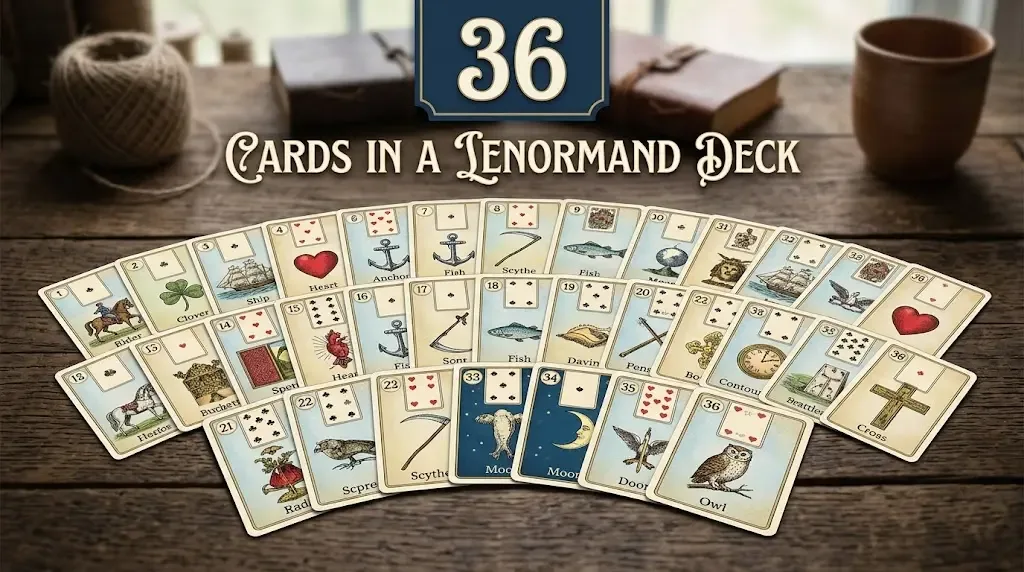
If you are new to Lenormand, one of the first things you may notice is that a Lenormand deck is much smaller than a Tarot deck.
A standard Lenormand deck contains 36 cards.
That number is one of the defining characteristics of the Lenormand system. Unlike Tarot, which traditionally contains 78 cards divided into the Major and Minor Arcana, Lenormand uses a compact set of 36 numbered cards, each with a simple and recognizable symbol.
But why are there exactly 36 cards? And how does such a small deck provide enough information for a reading?
Let’s take a closer look.
A Standard Lenormand Deck Has 36 Cards
The traditional Lenormand deck consists of 36 cards, numbered from 1 to 36.
Each card has a central symbol, such as:
Rider
Clover
Ship
House
Tree
Clouds
Snake
Heart
Ring
Key
Sun
Moon
Cross
The images are usually much more straightforward than Tarot imagery. A card showing a Heart, for example, naturally relates to love, affection, relationships, and emotional connections.
The simplicity of the individual cards is intentional. Lenormand readings depend heavily on how cards interact with one another rather than relying on a single card to provide a complicated symbolic interpretation.
The 36 Lenormand Cards
Here is the traditional sequence of the 36 cards:
No. | Card | Main Theme |
|---|---|---|
1 | Rider | News, arrival, movement |
2 | Clover | Luck, opportunity, chance |
3 | Ship | Travel, distance, exploration |
4 | House | Home, family, stability |
5 | Tree | Health, growth, roots |
6 | Clouds | Confusion, uncertainty |
7 | Snake | Complication, deception, strategy |
8 | Coffin | Ending, closure, transition |
9 | Bouquet | Gift, pleasure, invitation |
10 | Scythe | Sudden change, cutting, decision |
11 | Whip | Conflict, repetition, intensity |
12 | Birds | Conversation, nervousness, discussion |
13 | Child | New beginning, innocence |
14 | Fox | Work, caution, cleverness |
15 | Bear | Power, authority, protection |
16 | Stars | Hope, guidance, inspiration |
17 | Stork | Change, movement, improvement |
18 | Dog | Friendship, loyalty, support |
19 | Tower | Institution, distance, independence |
20 | Garden | Social life, public events, community |
21 | Mountain | Obstacle, delay, difficulty |
22 | Crossroads | Choice, alternatives, decision |
23 | Mice | Loss, worry, erosion |
24 | Heart | Love, affection, emotions |
25 | Ring | Commitment, agreement, partnership |
26 | Book | Knowledge, secrets, information |
27 | Letter | Message, document, communication |
28 | Man | Male querent or significant man |
29 | Woman | Female querent or significant woman |
30 | Lily | Peace, maturity, wisdom |
31 | Sun | Success, vitality, clarity |
32 | Moon | Recognition, emotions, intuition |
33 | Key | Solution, certainty, opportunity |
34 | Fish | Money, business, abundance |
35 | Anchor | Stability, security, persistence |
36 | Cross | Burden, fate, difficulty |
The exact wording of meanings can vary between readers and traditions, but the basic 36-card structure remains remarkably consistent.
Why Does Lenormand Have 36 Cards?
There is no single universally accepted explanation that says the Lenormand system was designed with 36 cards for one specific reason.
The modern Lenormand deck developed from the Petit Lenormand, a 36-card fortune-telling deck associated with the name of the famous French fortune-teller Marie Anne Lenormand.
Interestingly, the cards themselves are not simply a collection of abstract occult symbols. They draw heavily from familiar playing-card and everyday imagery.
This makes the system practical and relatively easy to recognize.
The number 36 also works particularly well for Lenormand's characteristic method of reading cards in combinations.
Instead of asking only:
“What does this card mean?”
Lenormand readers often ask:
“What happens when these cards appear together?”
That difference is extremely important.
Lenormand Is About Combinations
One of the biggest differences between Lenormand and Tarot is the way the cards communicate information.
Suppose you draw:
Heart + Ring
The Heart can indicate love and affection, while the Ring can represent commitment, partnership, or an agreement.
Together, they can suggest a romantic commitment or an important relationship.
Now consider:
Heart + Scythe
The Heart represents love, while the Scythe can indicate cutting, separation, or a sudden event.
The combination may suggest a sudden change in a relationship or an abrupt emotional decision.
The individual cards haven't changed.
What changes is the relationship between the cards.
This is why 36 cards can provide a surprisingly large range of interpretations.
Is a 36-Card Lenormand Deck Enough?
Absolutely.
In fact, the relatively small number of cards is part of what makes Lenormand so distinctive.
A Tarot deck has 78 cards, and individual Tarot cards can contain layers of symbolism involving mythology, astrology, numerology, elemental associations, visual details, and traditional esoteric meanings.
Lenormand generally works differently.
Its cards tend to be more concrete.
A House can point toward home or family.
A Letter can point toward a message or document.
A Ship can suggest travel, distance, or something coming from far away.
A Fish can relate to money, business, or abundance.
The deeper interpretation often comes from putting these simple concepts together.
For example:
House + Letter
could suggest a document related to a home, correspondence arriving at home, or important news concerning the family.
Fish + Ship
could point toward international business, overseas money, or financial activity connected with another country.
This combinational approach allows a relatively small deck to describe surprisingly specific situations.
How Many Cards Do You Use in a Lenormand Reading?
You don't necessarily use all 36 cards in every reading.
For a simple question, a reader might draw three cards.
For example:
Rider + Letter + Sun
This could describe positive news or successful communication arriving soon.
A longer reading might use five, seven, or nine cards, depending on the reader's method.
There is also the famous Grand Tableau, which uses the entire 36-card deck.
This is one of the most comprehensive Lenormand spreads. All 36 cards are laid out, allowing the reader to examine relationships between different areas of the querent's life.
So although a Lenormand deck contains only 36 cards, the entire deck can be used in a remarkably complex reading system.
Lenormand vs. Tarot: 36 Cards vs. 78 Cards
The difference in deck size is easy to remember:
Lenormand: 36 cards
Tarot: 78 cards
But the difference is not simply about quantity.
Tarot generally gives more room for symbolic, psychological, spiritual, and archetypal interpretation.
Lenormand tends to be more direct and situational.
For someone asking:
“What is happening in this situation?”
Lenormand can be particularly interesting because the cards often behave almost like words in a sentence.
You might think of a Lenormand reading as constructing a short sentence from symbols.
For example:
Rider + Letter + Fish
could be read as:
“News about money.”
Or:
Ship + Fish + Anchor
could suggest:
“Long-distance business becomes stable.”
The reading becomes clearer as the cards are connected.
Are All Lenormand Decks 36 Cards?
Traditional Lenormand decks contain 36 cards.
However, modern deck creators sometimes produce expanded or modified versions with additional cards, alternative artwork, or extra significators.
These can be useful for particular reading styles, but they should be distinguished from the traditional 36-card Lenormand system.
If you are learning Lenormand for the first time, starting with the standard 36 cards is usually the simplest approach.
Once you understand the traditional system, experimenting with expanded decks becomes much easier.
Do You Need to Memorize All 36 Cards?
Not necessarily all at once.
Trying to memorize 36 meanings in a single sitting is probably one of the least enjoyable ways to learn Lenormand.
A better approach is to learn the cards as practical concepts.
For example:
Heart → love
House → home
Letter → message
Ring → commitment
Mountain → obstacle
Sun → success
Then begin practicing combinations.
Once you understand how two or three cards interact, the system starts to feel much more natural.
Eventually, you may find that you don't need to consciously recall a list of meanings. You simply recognize what the cards are saying together.
The Real Strength of the 36-Card Lenormand System
The fascinating thing about Lenormand is that its strength doesn't come from having a huge number of cards.
It comes from how the cards interact.
Thirty-six simple symbols can create an enormous number of possible combinations.
A single card gives you a basic idea.
Two cards create a relationship.
Three cards can form a statement.
A larger spread can begin to describe an entire situation.
And when all 36 cards are used in a Grand Tableau, the same small deck becomes a remarkably detailed map of circumstances, relationships, events, and possibilities.
That's why the question isn't really:
“How can only 36 cards be enough?”
A better question is:
“How much information can 36 cards create when they are read together?”
And that is where the real character of Lenormand begins to emerge.
Frequently Asked Questions
How many cards are in a Lenormand deck?
A traditional Lenormand deck contains 36 cards.
Is Lenormand the same as Tarot?
No. Lenormand and Tarot are different divination systems with different histories, structures, imagery, and reading methods. Tarot has 78 cards, while traditional Lenormand has 36.
Can Lenormand be used with only three cards?
Yes. Three-card readings are a simple and popular way to practice Lenormand combinations.
What is the largest traditional Lenormand spread?
The Grand Tableau uses all 36 cards in the deck.
Do Lenormand cards have fixed meanings?
Traditional Lenormand cards have established core meanings, but their interpretation can change significantly depending on neighboring cards and the question being asked.
Final Thoughts
A traditional Lenormand deck has 36 cards, but its small size shouldn't be mistaken for simplicity.
Lenormand is a system built around combinations. The cards are relatively direct, but the relationships between them can produce surprisingly detailed messages.
If you're just beginning to learn Lenormand, don't worry about mastering every possible interpretation immediately.
Start with the 36 basic cards.
Learn what each symbol represents.
Then start putting two cards together.
That's when Lenormand stops looking like a deck of 36 separate pictures—and starts looking like a language.
Recommended reading
Lenormand vs Tarot: What Is the Difference Between These Two Systems?
Tarot and Lenormand are probably the two best-known card-based divination systems in the modern Western world. They are often mentioned together, and many…
The History of Lenormand Cards: From Fortune Telling to Modern Divination
Lenormand cards are one of the most fascinating divination systems in the world. Although they are often compared with tarot cards, Lenormand has its own…
An Introduction to the Grand Tableau: How to Read All 36 Lenormand Cards at Once
If you have spent any time exploring Lenormand cartomancy, you have likely encountered its ultimate signature reading: The Grand Tableau (GT). Unlike Tarot…
Simple Lenormand Spreads: How to Do 2-Card, 3-Card, and 9-Card Box Readings
Unlike Tarot—which leans heavily into archetypes, psychological reflection, and esoteric symbolism—Lenormand is a practical, direct system designed for…
Understanding the 36 Lenormand Cards: Meanings in Love, Career, and Daily Guidance
A clean, cheat-sheet guide to concrete symbols from The Rider to The Cross. Whether you’re drawing a quick Card of the Day or laying out a full Grand Tableau…