How to Read Lenormand Card Combinations: Moving Beyond Rigid Rules to Real Context
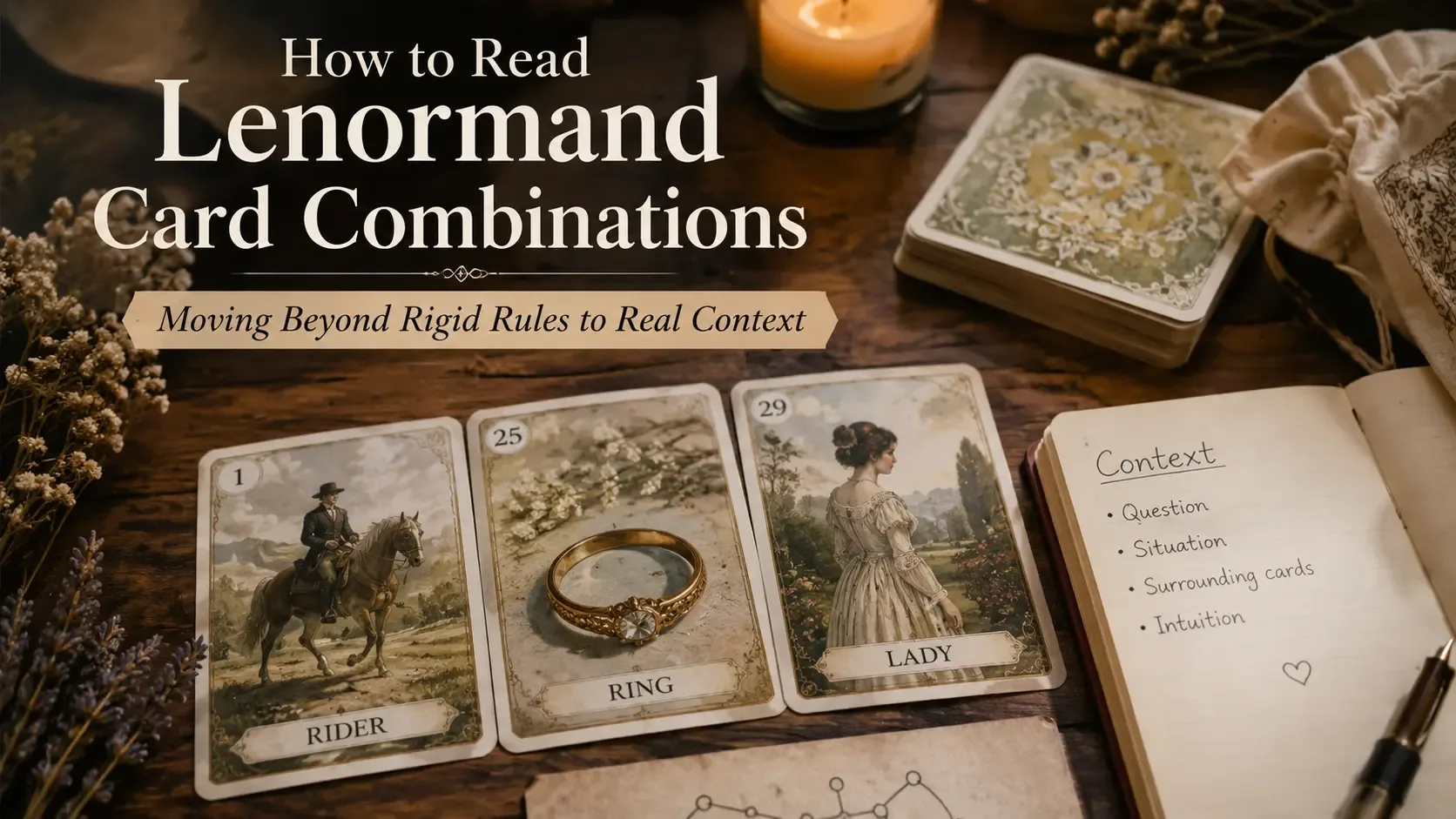
If single Lenormand cards are the building blocks of a reading, combinations are where the story actually happens.
Unlike Tarot—where pulling a single card often gives you enough visual and symbolic weight for an in-depth reading—Lenormand is fundamentally a paired system. A single Lenormand card like The Clover or The Ship rarely gives a full answer on its own. It is only when two or more cards interact that clear, actionable meaning emerges.
However, many beginner tutorials oversimplify combination reading by teaching a rigid formula: "Card A is always the noun, and Card B is always the adjective."
While that formula is a helpful starting point, relying solely on it can make your readings feel forced or incomplete. In practice, two Lenormand cards interact in far richer, more dynamic ways.
Here is how to break free from mechanical rules and master the art of reading Lenormand combinations naturally.
1. The Classic Baseline: Modifier & Core (and Why It Works Both Ways)
The traditional method of reading two Lenormand cards is to view one as the Core Subject and the other as the Modifier.
Forward Modification (Card A modifies Card B):
Card A (The Clover) + Card B (The House)
Clover = Lucky / Brief / Small
House = Home / Family / Property
Reading: A brief period of good fortune at home.
Reverse Modification (Card B modifies Card A):
In real readings, your intuition or the flow of the spread may dictate that the second card describes or qualifies the first card.
Card A (The Ship) + Card B (The Letter)
Instead of just reading "a traveling message," you might see The Ship (a journey or transition) as the main event, and The Letter (written news) as the medium through which it manifests—A transit or move that is confirmed via official written notice.
The direction of modifier and noun is flexible. Do not lock yourself into a single direction if the context of the question points otherwise.
2. Dynamic Relational Combinations: Beyond Nouns and Adjectives
Two Lenormand cards do not just act as words in a basic grammar exercise; they establish a relational logic with each other. Depending on the question asked, their relationship often falls into several distinct categories:
A. Cause and Effect (Causality)
One card represents the trigger or source, while the other represents the resulting outcome.
The Scythe (20) + The Heart (24)
Rather than just "a sudden heart," the abrupt energy of The Scythe cuts into The Heart—signifying sudden emotional pain, an unexpected breakup, or a sudden decision in love.
B. Location and Environment (Spatial Relationship)
One card establishes where something happens, while the other defines what is present.
The Park (26) + The Fox (14)
The Park represents a public venue or community, while The Fox represents caution, stealth, or professional work.
Reading: Cunning or deceptive behavior in a public space, or a highly competitive corporate environment.
C. Condition and Contingency (If / Then Dynamics)
Sometimes, the first card sets a prerequisite or roadblock for the second card to manifest.
The Mountain (21) + The Key (33)
The Mountain represents a heavy delay or obstacle, followed by The Key (the solution/certainty).
Reading: Success or a breakthrough will come, but only after overcoming a significant delay.
D. Time and Sequence (Chronology)
In practical readings, two cards often layout a timeline of events unfolding sequentially.
The Bouquet (9) + The Ring (25)
The Bouquet (a pleasing invitation or gift) leads directly into The Ring (a contract or commitment).
Reading: A pleasant proposal that leads to a binding agreement.
3. Context is King: How the Question Reshapes the Combination
The exact same pair of cards will mean completely different things depending on the real-world context of your question. Never read combinations in a vacuum.
Consider the pair: The Dog (18) + The Anchor (35)
In a Career Reading: A loyal business partner, or long-term job stability with a trusted team.
In a Relationship Reading: A deeply devoted, unwavering friend or partner who provides lasting security.
In a Location / Daily Reading: Staying put in a familiar, safe environment.
Before jumping into dictionary definitions, always ask yourself: "What realm of life does this question belong to?"
4. Tips for Practicing Lenormand Combinations
Start with 2-Card Pulls Daily: Draw two cards each morning. Ask a simple, concrete question like "What will the energy of today's afternoon meeting be?"
Look for the Interaction, Not Just Sums: Don't just add Definition A + Definition B. Ask yourself how the two symbols physically interact in real life (e.g., how a Key interacts with a Door/House, or how a Scythe cuts through a Clover).
Keep a Reading Journal: Record your initial interpretation, and then re-examine it at the end of the day to see how the real-world events actually played out.
Master Combination Practice in Seconds
Understanding how Lenormand pairs interact takes practice, but exploring different combinations shouldn't be tedious.
Whether you are looking to test out daily 2-card draws, look up card meanings across different contexts, or practice interactive readings, explore the clean, ad-free card tools right now at lenormand.live.
Recommended reading
How Many Cards Are in a Lenormand Deck?
If you are new to Lenormand, one of the first things you may notice is that a Lenormand deck is much smaller than a Tarot deck. A standard Lenormand deck…
Should Beginners Learn Tarot or Lenormand? A Complete Guide to Choosing the Right System
If you are just starting to explore divination, you may quickly come across a common question: Should I learn Tarot or Lenormand first? At first glance, both…
Lenormand vs Tarot: What Is the Difference Between These Two Systems?
Tarot and Lenormand are probably the two best-known card-based divination systems in the modern Western world. They are often mentioned together, and many…
The History of Lenormand Cards: From Fortune Telling to Modern Divination
Lenormand cards are one of the most fascinating divination systems in the world. Although they are often compared with tarot cards, Lenormand has its own…
An Introduction to the Grand Tableau: How to Read All 36 Lenormand Cards at Once
If you have spent any time exploring Lenormand cartomancy, you have likely encountered its ultimate signature reading: The Grand Tableau (GT). Unlike Tarot…